Physical Layer Model
XLRON ships an end-to-end closed-form ISRS GN model with distributed Raman amplification (DRA), Nyquist digital subchannels, EGN modulation-format correction, and a Friis-cascade noise-figure model for hybrid Raman+EDFA amplifiers. Among the open-source optical-network simulation libraries, XLRON is the only one to combine all of these features in a single physical layer model.
The model is described in detail in GN Model Physical Layer and Differentiable DRA Pipeline. This page summarises the validation against the Gerard et al. 2025 record-throughput experiment and the resulting capabilities for design and optimization.
| Feature | GNPy | XLRON |
|---|---|---|
| GN NLI model | ✓ | ✓ |
| EGN correction (modulation format) | ✗ | ✓ |
| ISRS in GN model | Partial | ✓ |
| Distributed Raman | ✓ | ✓ |
| Nyquist subchannels | ✗ | ✓ |
| ASE noise | ✓ | ✓ |
| Multi-band | Partial | ✓ |
| Polarization effects | ✓ | ✗ |
| ROADM impairments | ✓ | ✗ |
| Connector losses | ✓ | ✗ |
| Differentiable | ✗ | ✓ |
Validation against Gerard et al. 2025
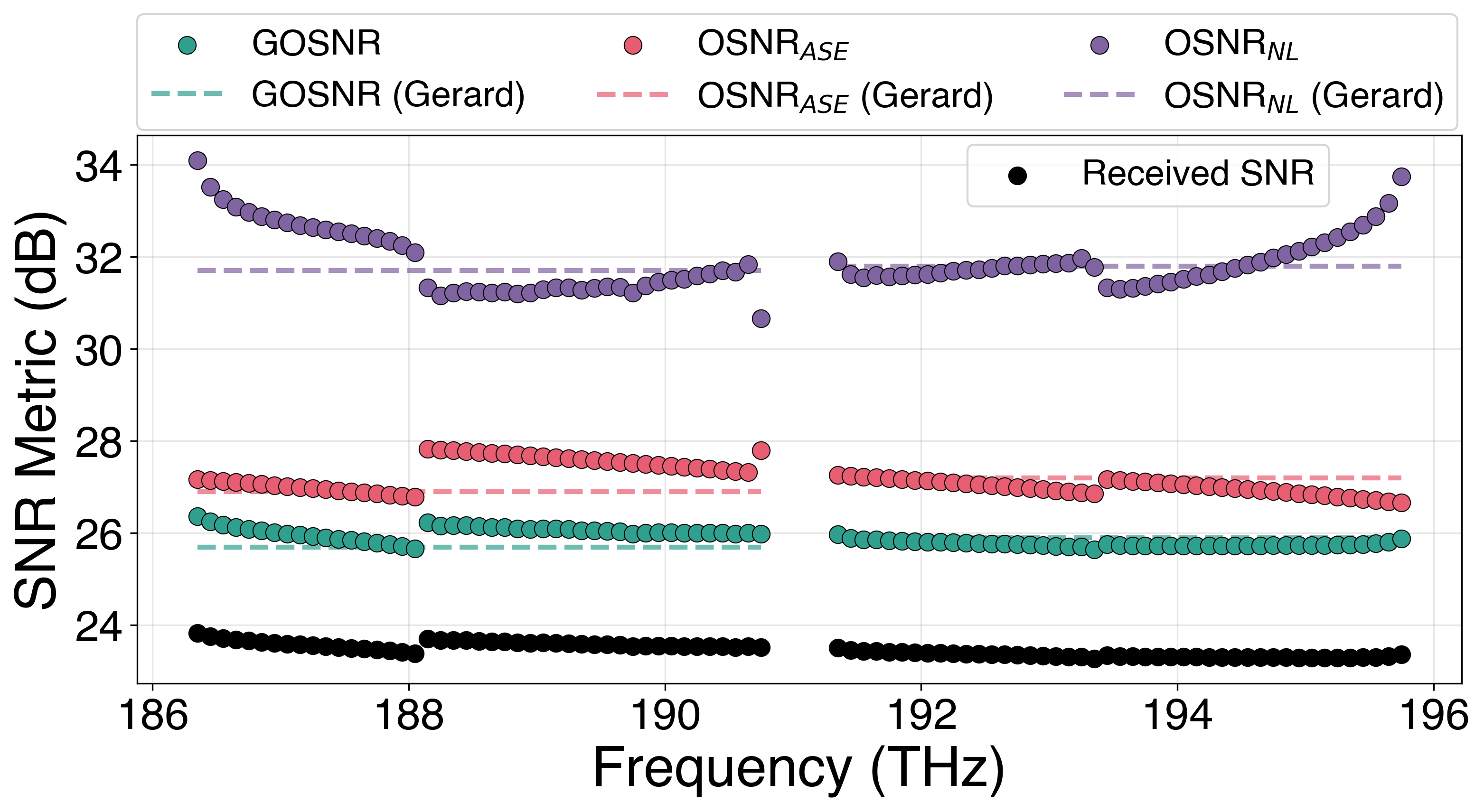
The Gerard et al. 2025 experiment demonstrated 72 Tb/s real-time transmission over 1,504 km of G.654.E TXF fiber across the C+L bands using hybrid backward-Raman + EDFA amplification — 90 channels of 100.4 GBd PCS 64-QAM, 18.4 dB span loss, ~8.7 dB Raman gain. We reconfigure XLRON's rsa_gn_model to match the experimental setup as closely as possible, then compare every SNR metric per channel.
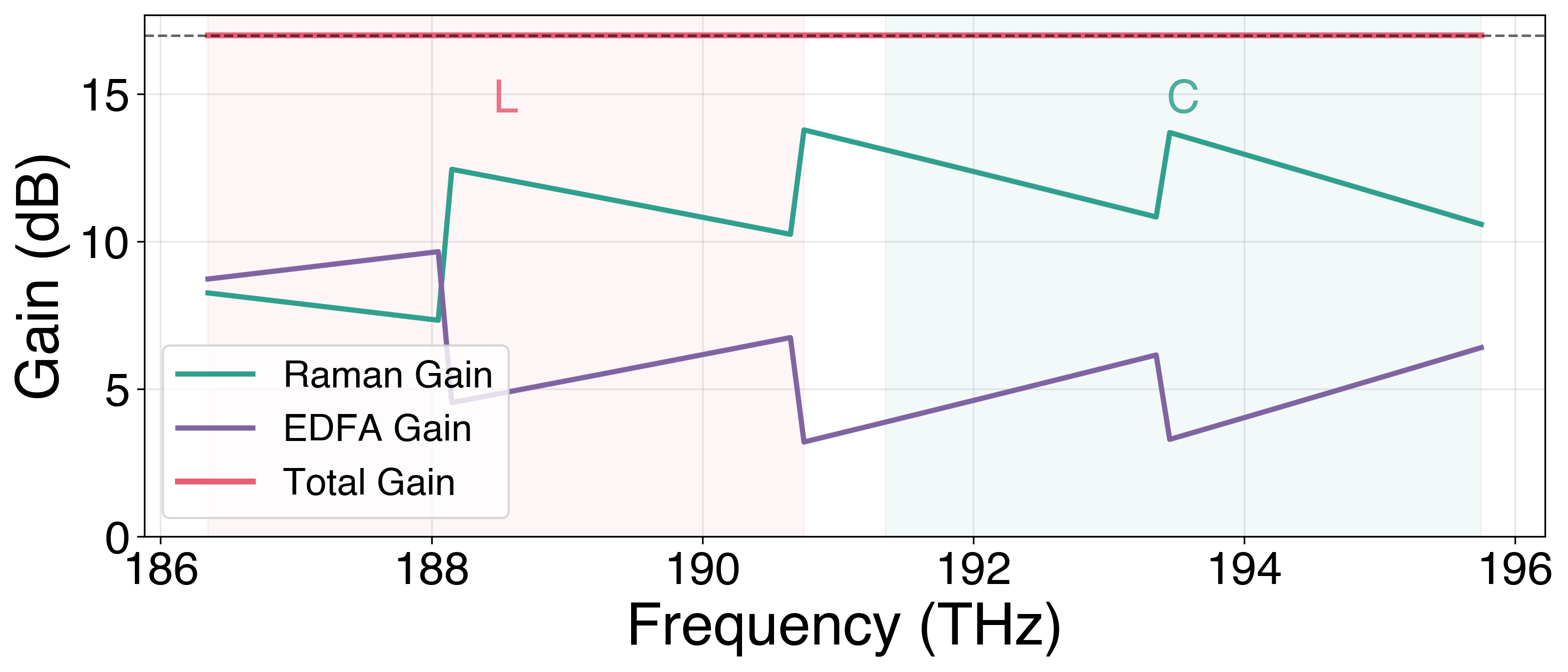
Gain budget. Raman provides 11 dB on average, EDFA 6 dB, total 17 dB matching span loss:
Per-channel SNR metrics (GOSNR, OSNR_ASE, OSNR_NL, received SNR) compared against the per-band averages reported in Gerard et al. Table I:
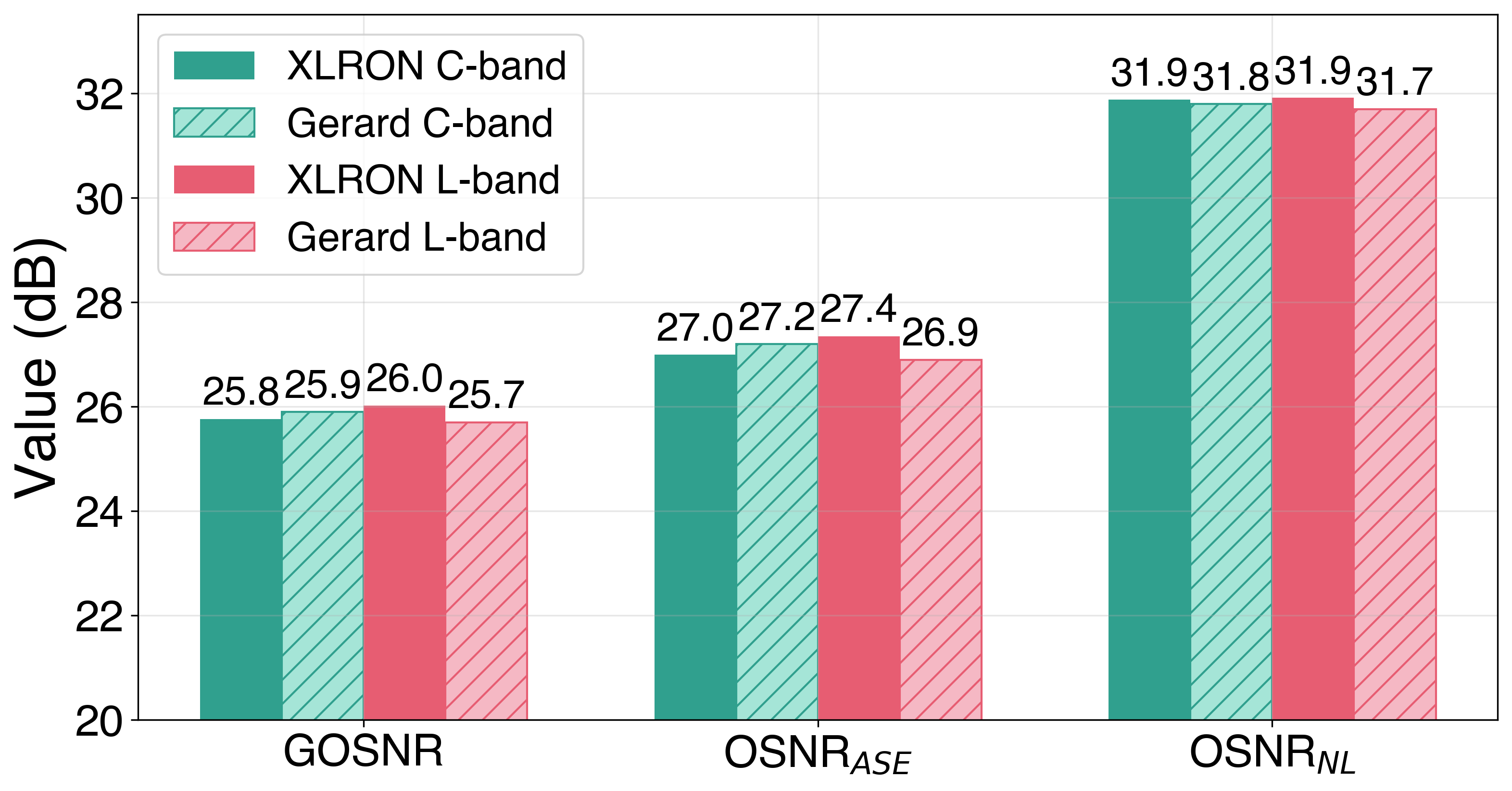
Per-band agreement is within 0.5 dB on every metric:
| Metric | Band | XLRON | Gerard | Δ |
|---|---|---|---|---|
| GOSNR | C | 25.8 dB | 25.9 dB | 0.1 dB |
| GOSNR | L | 26.0 dB | 25.7 dB | 0.3 dB |
| OSNR_ASE | C | 27.0 dB | 27.2 dB | 0.2 dB |
| OSNR_ASE | L | 27.4 dB | 26.9 dB | 0.5 dB |
| OSNR_NL | C | 31.9 dB | 31.8 dB | 0.1 dB |
| OSNR_NL | L | 31.9 dB | 31.7 dB | 0.2 dB |
Ablation study: removing components of the model (DRA, Nyquist subchannels, coherent multi-span NLI accumulation) shifts the predicted optimal launch power by several dB and the GOSNR by 1–2 dB:
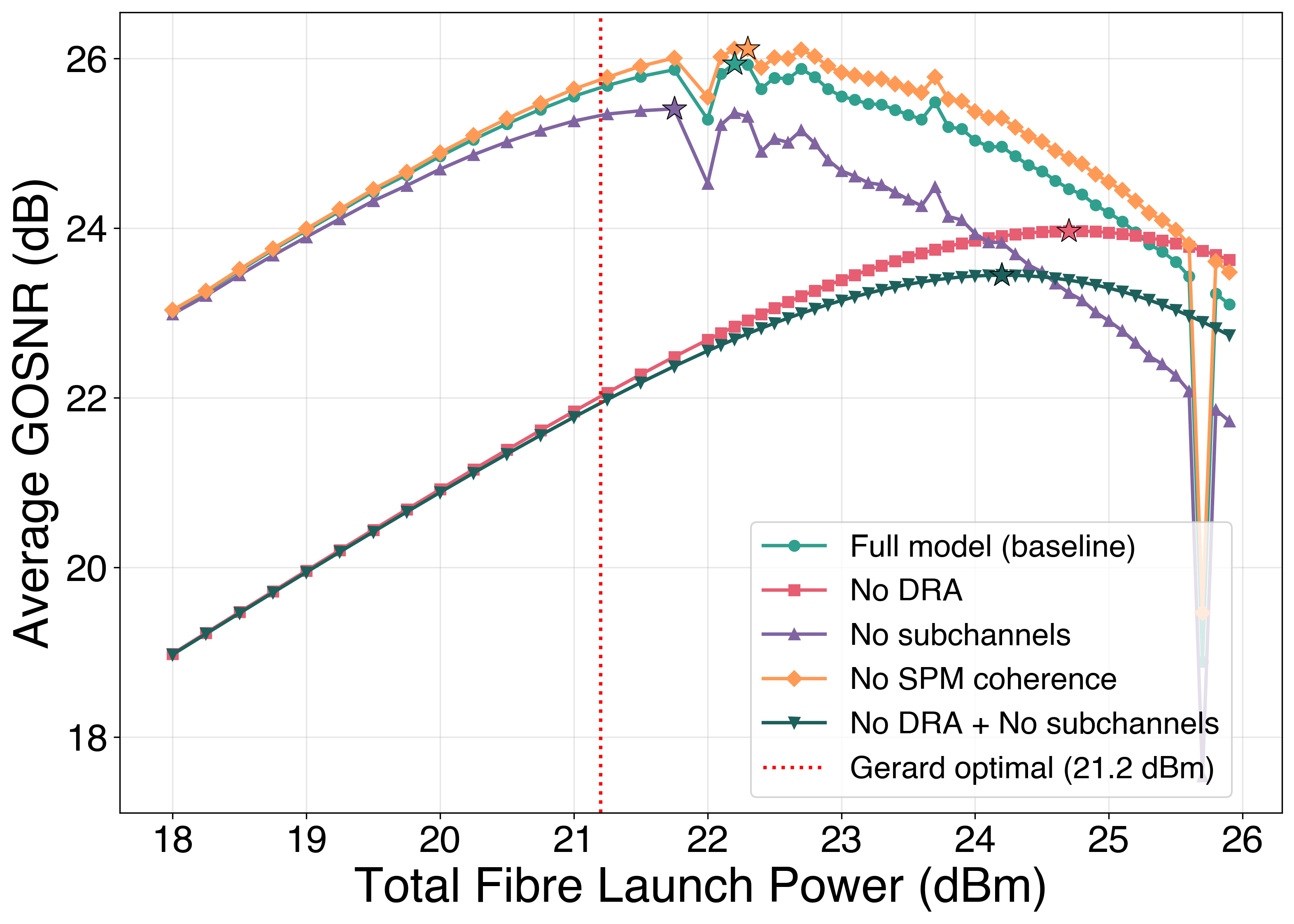
The full XLRON model peaks at 25.8 dB GOSNR at ~22 dBm total fibre launch power, in close agreement with Gerard's experimentally optimal 21.2 dBm.
Gradient-based Raman pump optimization
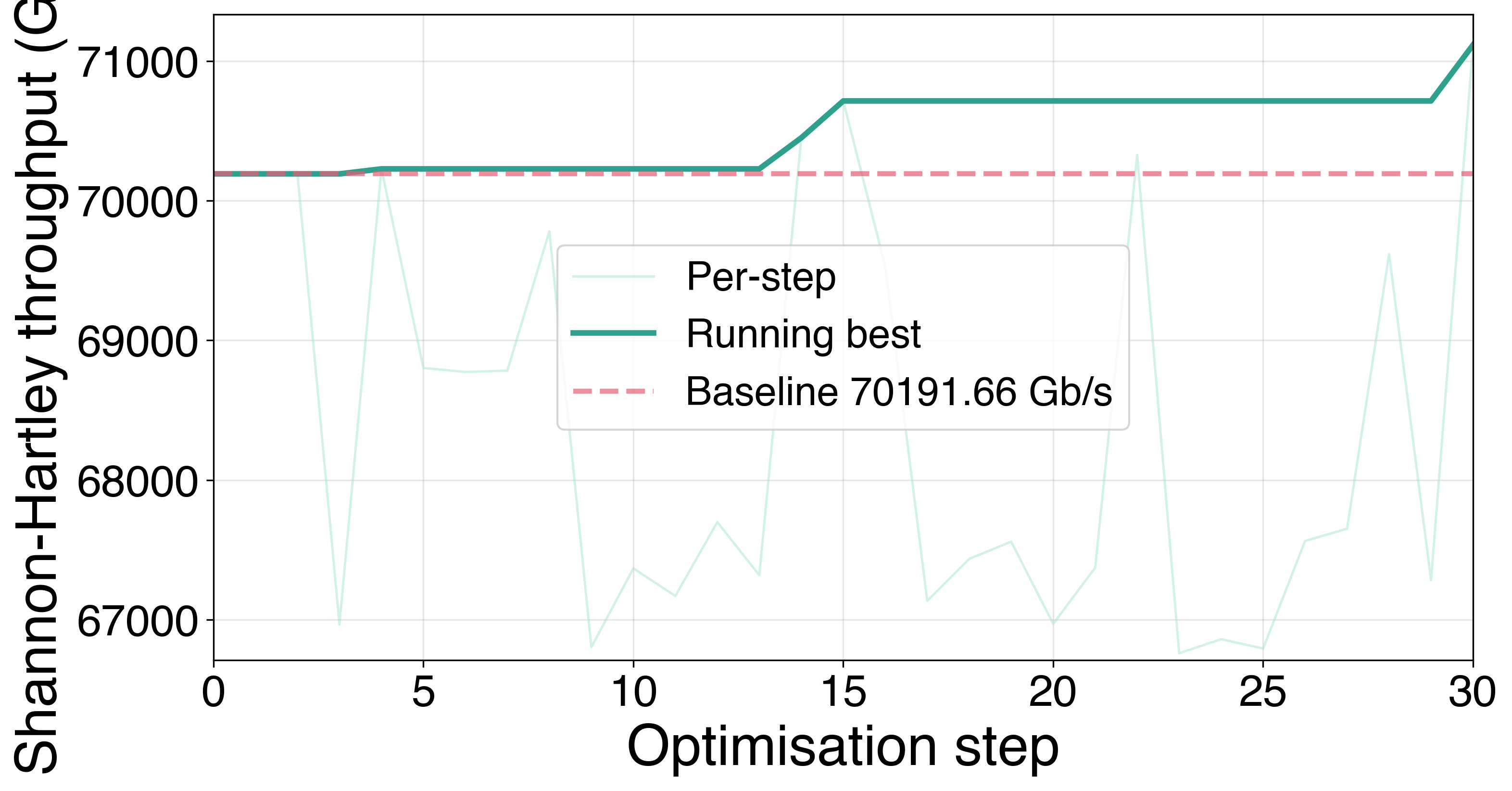
Because the entire DRA + ISRS GN pipeline is differentiable end-to-end (Implicit Function Theorem for the Raman ODE solve, custom JVP for the LM profile fit, see Differentiable DRA Pipeline), Raman pump powers can be optimized with first-order gradient methods instead of derivative-free PSO.
Starting from a deliberately suboptimal flat pump configuration, Adam raises the total Shannon–Hartley throughput from 70.2 Tb/s to 71.1 Tb/s within 30 iterations on a laptop CPU:
To our knowledge, XLRON is the first end-to-end differentiable physical-layer simulator for wideband ISRS GN systems with distributed Raman amplification.
Reproduce all of the above with the commands in the XLRON framework paper reproduction guide.